
Welcome to Part 2 of this Irish Coin History Timeline!
We started our Irish Coin journey in the Bronze Age and now we find ourselves in the 1400s. The Age of Exploration changed the way the British practiced colonialism. Territory expansion for monetary gain required England to streamline and standardize its economic practices and that greatly affected Irish coinage.
Irish Images on Irish Coins
- In the late 1400s, Edward IV was making Irish tokens when he declared Ireland should have coins of entirely Irish design. He placed a rose in the center of the cross for the reverse but he died before the groats were minted.
- His brother Richard III changed the design to the “three crowns” Irish groats and pennies.
- In 1493, Henry VII reinstated the King’s portrait and long cross designs, but Irish economies were suffering at the hands of the colonialists and so were forced into dependency on English money that had been minted on finer planchets.
Introduction of the Cláirseach
- While married to Anne Boleyn, Henry VIII revamped Irish coinage. He replaced the long cross with the Tudor Shield and added the Irish harp to the obverse. The coins were minted in London, and at this time he declared himself “King” of Ireland. He also reduced the fineness of the English planchets. That change increased the relative value of the Irish planchets.
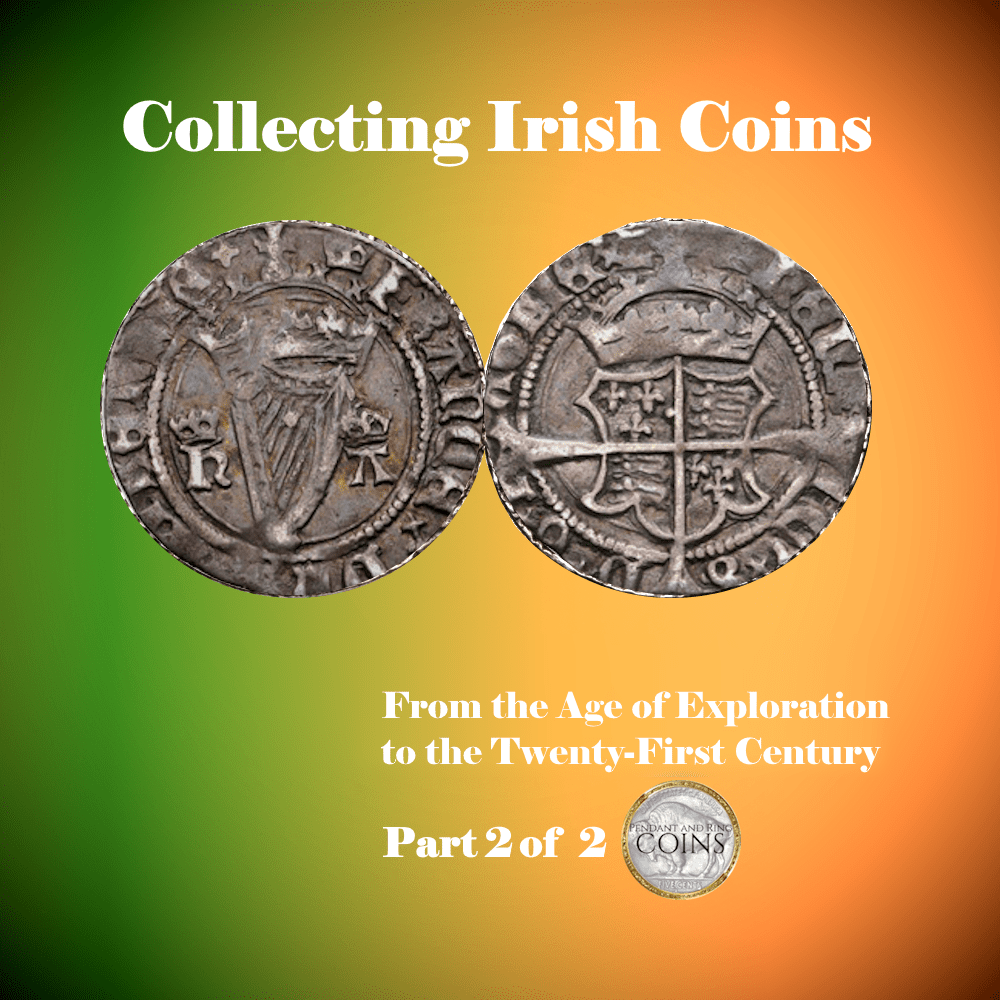
- Edward VI opened a Dublin mint and restored the fineness of English planchets, thus devaluing the lesser silver, Irish planchets. He also introduced copper planchets into the Irish market.
- Mary I maintained a large harp design, minting one coin series with only her portrait and then a second coin series with her portrait facing Philip II’s portrait.
- Elizabeth I changed the harp design to feature a shield with three harps, two on top and one centered beneath. She also struck more copper coins for Irish circulation and brought back token coinage like Edward IV had produced.
- James I reinstituted the large harp and restored fineness to sixpence and shilling planchets.
- When numerous wealthy Irish Earls emigrated to Spain in 1607 the Irish economy suffered. Coins of Irish, English, and other origin were used in local trade. Their value was based on the coin’s silver weight. External trade was severely hampered.
Rebellion and Civil War
- Under the direction of local leaders, including the Duke of Ormond, craftsmen began making silver-plated coins to pay soldiers during these difficult years. Ormond stamped the denomination on one side and the crowned initials CR were stamped on the other side.
- In 1634 English King Charles I called the Irish Parliament to get Ireland back in good financial standing. He received a great deal of support from the Catholic population in Ireland.
- The Duke of Ormond also minted Irish gold coins called single and double pistoles. with monetary values of 13 and 26 shillings. The pistole weighed .215 troy ounces, and the double weighed .429 troy ounces. There are only 11 known to exist.
They had no royalty or state markings but were stamped with weight and value designations. The lack of governance in their making means that are not technically coins so they are also called pistole pieces, and pistole pledges. - Rebel money was made in Kilkenny, bearing the traditional longcross design.
- Copies of London-minted halfcrowns were hammered to ease shortages during the conflict. They show a harp mintmark and are called Blacksmith’s Halfcrowns.
- With the English Throne in question, a multitude of Irish tokens were made all across the island. The harp is a popular motif seen opposite a local landmark or Saint’s visage.
* These tokens have such cultural significance, I felt they deserved a place in this timeline. The numerous Irish Token varieties created during the mid-17th century would take weeks to explore. *
The Stuarts Take the English Throne
- Charles II minted halfpenny and halfpence on copper planchets with the large harp.
- James II continued the use of copper planchets for halfpenny and halfpence creation until his abdication. Coin production ceased from 1689 until 1692.
- In the interim, Ireland made gunmoney. As legend would have it, people melted all the metal they could find, including their guns to mint the coins. In reality, weapons were at a premium, but other metal implements were fair game. From his base in Dublin, dethroned James II gave license to mint brass half-crowns, shillings, and sixpences. The local population supported James II and gladly minted coinage to aid his fight.
- In 1692 William and Mary minted halfpennies with large harps.
- After Mary’s death, William maintained the large harp design until 1722.
- In 1722 a clever man named William Wood bought a coin patent from the King’s mistress and made halfpennies and farthings for Ireland, but the Irish did not like the new design.
- Wood’s design showed a seated Hibernia with the beloved harp resting at her feet.
- His patent was surrendered in 1742 under great pressure from petitioning Irish.
- His coins were sent to British colonies in North America, and used as continental coinage. Since then, the coins are more common in the US than they are in Ireland.
- George II ordered copper halfpennies and farthings with the large harp design, and a laurel-crowned bust until 1760.
- George III ordered halfpennies but not farthings then shipped some to the Loyalists in North America, and eventually, there was a coin shortage in the Isles. Factions in parliament stepped in, in his stead, and permitted the production of Irish tokens to prevent financial collapse.
The 19th Century
- The coin shortage continued so the Bank of Ireland began importing Spanish 8 Reales for circulation.
- Matthew Boulton gets involved. Boulton was a renaissance man. As a businessman, he sought to solve the Irish coin shortage and turn a profit. As a silversmith, he designed new pennies, halfpennies, and farthings. As an engineer, he improved the production quality and capacity of coin-making machines with steam technology which saved money in his business venture.
- He opened a Soho mint and used his mechanization to mint tokens and coins for Ireland. The tokens and coins were copper and of such quality that even the circulated runs are often called proofs.
- George the IV minted a small run of pennies and halfpennies for Ireland with the large harp, but by the 1820s the country was awash in English currency.
- For one hundred years, English money was used in Ireland and no Irish coins were minted.
Irish Free State
- In 1921, the Anglo-Irish treaty led to the establishment of the Irish Free State.
- In 1926, Mr. Percy Metcalfe, a noted British sculptor and medallist began designing coinage for the new state.
- In 1928, Ireland minted the large harp coins with new designs.
Bronze one-quarter Phingin, or Feoirling showed the Eurasian woodcock.
Bronze half-pingins showed a sow and piglets.
Bronze pingins showed a hen and chicks.
Silver three pingins, or a half ruel, showed the Irish hare.
Silver six phingin, or one ruel showed the Irish wolfhound.
Silver scillings showed the Irish Bull.
Silver two-scilling or flóirin showed the Salmon.
Silve half-coróin, equal to two scilling and six pingin showed the Irish work horse. - WWII caused pauses in coin production, not just in Ireland but in many nations. When minting resumed, previously silver coins were made with cupro-nickel.
- In 1966, Ireland minted a commemorative ten scilling coin for circulation. The coin featured the bust of bust of Padraig Pearse and the figure of Cú Chulainn to commemorate the Easter Uprising of 1916.
- In 1971, Ireland migrated to the decimal system. The new coins retained the same imagery.
Bronze half-pennies showed spiraling hooked-beak crane-like Bird of Kells.
Bronze pennies showed a peacock-like Bird of Kells.
Bronze two-pennies showed a boat or harp-like Bird of Kells.
Cupro-nickel five pence showed an Irish bull.
Cupro-nickel ten pence showed a Salmon.
Cupro-nickel fifty pence showed a Eurasian woodcock. - In 2002, Ireland joined the multi-national euro system. Irish euros maintain a mid-sized harp on the obverse and show the denomination and relief of the Island on the obverse.
- In 2004, the non-circulating 10 euro was released. It shows a Celtic-stylized swan surrounded by ten stars that represent the 10 nations that joined the EU in 2004. This is the first of many non-circulating Irish euros that celebrate Irish coin-design heritage.
Since 2004, other coins have been added to the Irish collection, but only as recirculating coin varieties. Although these are beautiful and many, they are not something one is likely to find in the change jar.
Thank you for joining us on this fantastic voyage.
Subscribe for more history and we’ll see you next time on Pendant and Ring.
 Pendant and Ring
What do you think?