
Part II
Hello and Welcome to Pendant and Ring’s second installment in a new series called:
Jewelry 101.
In the last installment, we looked for artistic clues to tell when an artisan crafted your jewelry. We covered the past 100 years of art, divided by era.
Today, we explore the past century of jewelry through a different lens: activist jewelry. The heightened emotions accompanying activism prompt the creation of readily identifiable art pieces, including jewelry.
Political campaigns have used buttons and pins since Abraham Lincoln ran for office in 1860 [1]. Brooches, pins, buttons, and closures have a long history, stretching back to Iron Age fibulae [2]. Fibulae are cloak closures, a functional piece of gear that lent itself to ornamentation.
In the early 20th century, cause pins entered the scene. The Suffragettes in the US and the UK wore buttons to support the movement. These women sought the right to vote, and after years of successful organizing, they got it.
In addition to “VOTES FOR WOMEN” pins [3], suffragettes made other jewelry items to celebrate victories. Two UK jewelry artists typified the movement with pendants and brooches, Ernestine Mills [4] and Millicent Fawcett [5].
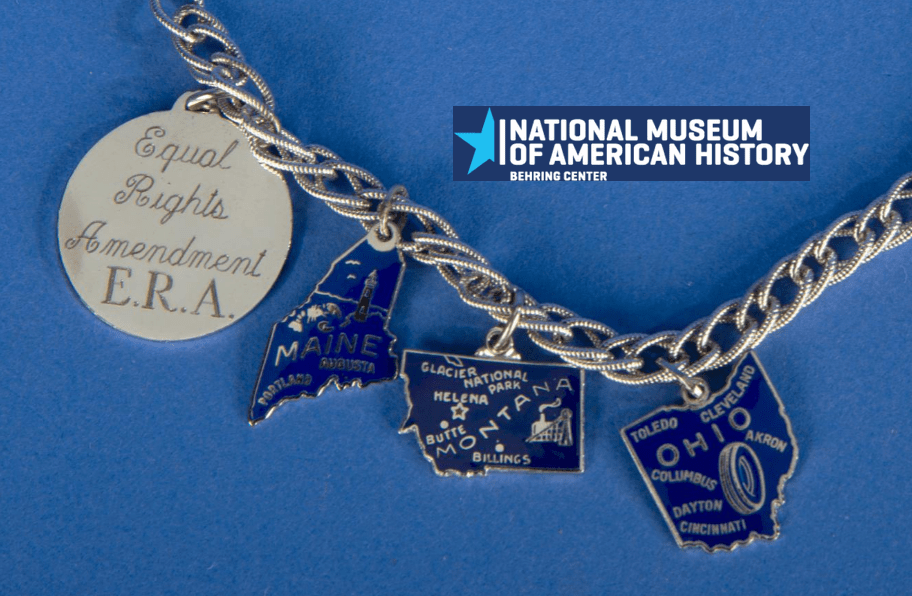
After achieving suffrage, the women of the world sought Equal Rights. In 1923, in the US, Alice Paul drafted the Equal Rights Amendment. Supporters crafted numerous jewelry items to support the movement. Pieces included charms to show support and to celebrate success. Some charms, like on the bracelet included here, depicted states that ratified the amendment.
Numerous factors, including The Great Depression, led to WWII. WWII brought Trench Art to the forefront. GIs made love tokens from coins and bits of silver they collected in their travels. These handmade items hearken back to the early days of silver embellishment because the soldiers used hand tools to produce them.
At the same time, people engaged in silent resistance to oppose German occupation. Members of the underground resistance had to be creative because the production of anything for the resistance was dangerous. One way to resist was to wear banned coinage as jewelry [7]. Pins and brooches were the easiest to make and the most popular.
In the American South, Operation Dixie got rolling. In 1944, the International Harvester Company introduced the mechanical Cotton Picking Machine, thus revolutionizing labor. After WWII, the soldiers returned to a racially divided US with fewer jobs. Labor Unions tried to organize in the South but met with layers of institutionalized racism.
Operation Dixie mobilized to protect workers’ rights but did not achieve their aims [8]. Nonetheless, scholars consider this event a precursor to the Civil Rights Movement. People in Unions and the Civil Rights Movement produce activist jewelry rooted in resistance.
The raised fist is a popular image associated with civil rights, workers’ rights, and general resistance. You can find the raised fist rendered as a pin, pendant, charm bracelet, tie-tack, cuff-links, and any other jewelry item you can think of. It is much older than the Civil Rights Movement; the raised fist dates back to the 1848 French Revolution that birthed the Second Republic [9]. Raised fist jewelry comes in many colors, representing the different causes.

The Civil Rights Movement raged through the fifties and sixties, alongside the Vietnam War and accompanying protests. Protesters had many symbols, including love beads to protest the rigid societal structure of the 1950s, flowers for flower power, peace signs, and the raised fist, especially when protesting the draft. Many jewelry items from the era are with us today.
In the ’70s and ’80s, the LGBTQ community marched, the Equal Rights Amendment returned to center stage, and protesters brought more attention to the South Africa Apartheid. The LGBTQ community rallied under the rainbow Pride Flag, created by Gilbert Baker in 1978 [10]. Feminists wore female symbol (♀️) jewelry to show support for the Equal Rights Amendment. Activists wore “End Apartheid” buttons and pins to show support as they marched in support of Nelson Mandela and other anti-apartheid figures.
In the 1990s, the US went to war in the Middle East. Internationally, people protested the Gulf War with strikes, marches, rallies, and slow work. [11] Most media outlets in the Western world focused on the “Support our Troops” movement that did not look at issues regarding the conflict but encouraged care for those in the line of fire. The movement revived the Yellow Ribbon as their emblem [12]. Artisans produced enameled Yellow Ribbon pins and sold yards of physical ribbon to tie around trees and car antennae. In addition to the Yellow ribbons, Red ribbons appeared in 1991 as a symbol of AIDS awareness created by the Visual AIDS artist group. [13] The Black Power Fist and the Anarchy A gained popularity in activist jewelry design in the 1990s, although both symbols existed since the 1970s.
Since the year 2000, activists have continued the fight for equal rights. People wore white wristbands to demand equal access to marriage. [14] People wear Safety Pins to symbolize that they are a safe person. [15] The English started wearing safety pins to show solidarity with people threatened by Brexit, and then the US picked up on the trend. The idea of a “safe person” is an extension of Safe Spaces for minorities in danger.
Thank you for joining us for this second installation of Jewelry 101, which explores activist jewelry from the last century. It all began with political campaign pins, Suffragettes in the early 1900s, soldiers making Trench art, and secret resistance jewelry that evolved during World War II. The raised fist represents labor unions and civil rights actions. While anti-apartheid and LGBTQ pride jewelry were popular in the 1970s and 1980s, the 1990s saw the introduction of red ribbons for AIDS awareness and yellow ribbons for soldier support. Symbols such as safety pins for unity and white wristbands for marriage equality gained popularity in the 2000s.
Time for the pop quiz. ✅✅✅
1.) When did the raised fist first appear in activist art?
- 2005
- 1967
- 1848
2.) Who was the first US president to make political campaign pins?
- George Washington
- Abraham Lincoln
- Richard Nixon
3.) When was the QLBGAIT+ Pride Flag created?
- 1978
- 1968
- 1958
Answers: 8ㄥ6⇂ (˙Ɛ uloɔuı˥ ɯɐɥɐɹq∀ (˙ᄅ 8ㄣ8⇂ (˙⇂
In 2024, activists still fight for equal rights in all walks of life. The artistic outpouring from the activist community continues to influence fashion and jewelry design.
🥳 Let us know how you did in the pop quiz, and tell us what you would like to cover in this series in the comments below! 🧐
Subscribe to learn more about identifying jewelry, and jewelry history.
Read more from the Jewelry 101 series.
Visit a Pendant and Ring Store to find your next treasure!
NOTES
[1] Abraham Lincoln campaign button. https://www.loc.gov/item/2011647968/
[2] Iron Age Fibulae. https://www.forumancientcoins.com/numiswiki/view.asp?key=iron%20age%20fibula
[3] Votes for Women pin. https://buttonmuseum.org/buttons/votes-women
[4] Ernestine Mills pendant artist. https://www.museumoflondon.org.uk/museum-london/explore/who-were-suffragettes
[5] Millicent Fawcett brooches. https://www.museumoflondon.org.uk/discover/millicent-fawcetts-suffragist-brooch
[6] ERA bracelet image. https://americanhistory.si.edu/collections/nmah_1066423
[7] Coin Jewelry WWII resistance. https://trc-leiden.nl/trc-digital-exhibition/index.php/textile-tales-from-the-second-world-war/item/226-some-post-war-items
[8] Operation Dixie. https://www.jstor.org/stable/j.ctv941x0c
[9] The first instance of a raised fist. https://blog.phillipscollection.org/2013/07/17/spotlight-uprising-revolution/
[10] Pride Flag. PDF. https://www.austintexas.gov/sites/default/files/files/ATD%20PIO/Smart%20Mobility/Pride%20Flag%20Update%2005.26.22.pdf
[11] Gulf War Resistance. https://libcom.org/article/1990-1991-resistance-gulf-war
[12] Yellow Ribbons. https://www.nytimes.com/1991/02/03/us/war-in-the-gulf-home-front-war-s-ribbons-are-yellow-with-meaning-of-many-hues.html
[13] Visual AIDS. Timeline. 1991. https://visualaids.org/history
[14] White wristbands. https://www.nytimes.com/2012/11/03/us/standing-up-for-gay-marriage-at-a-straight-wedding.html
[15] Safety Pins. https://www.asanet.org/news_item/safety-pins-awareness-ribbons-and-challenges-new-symbols/
 Pendant and Ring
What do you think?