
Welcome to the third installment in the Jewelry 101 series. This article is about vintage and new jewelry. We will cover the last 100 years of jewelry-making to provide definitions and present the consensus of the jewelry industry regarding Costume, Fashion, and Fine jewelry.
Antique jewelry is more than one hundred years old. Jewelers discuss eras and techniques to categorize older jewelry, but newer jewelry is readily divided into the following three categories.
Let’s begin with definitions.
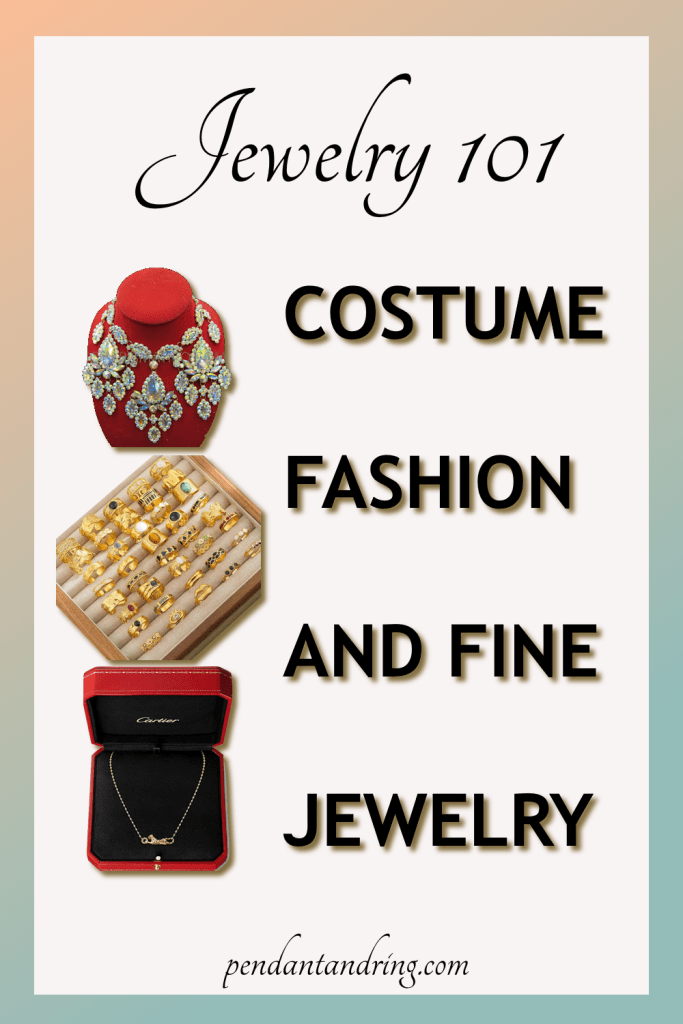
Costume Jewelry is fun, glittery, sometimes audacious, and trendy. It is also low-cost, mass-produced, consumable, and usually plated copper jewelry. The “gems” are wood, glass, plastic, acrylic, or lucite beads threaded or glued in place. Costume jewelry is typically machine-made in vast quantities.
Fashion Jewelry is pretty, inexpensive, sweet, and seasonal. It bridges the gap between low-cost costume jewelry and high-cost fine jewelry. Fashion jewelry pieces have seasonal runs composed of plated metals or solid brass, bronze, or copper. Pieces can include semi-precious lab-grown stones secured with wire or proper settings. Fashion jewelry can be made by machine and finished by hand or handmade.
Fine jewelry is timeless and heirloom quality. The pieces are unique and adhere to traditional techniques. Fine jewelry carries a higher cost and will last the longest. They are often one-of-a-kind, custom, handmade, or numbered and very limited-run production. Fine jewelry uses precious metals, natural precious stones, and proper settings.
Jewelry History
Fine jewelry is the oldest surviving jewelry. During the Stone Age, all jewelry was handmade and heirloom quality but made of raw gems, bone, claw, wood, stones, and ores. Later, Sumerian metallurgy allowed for the creation of electrum and gold beads. Silver followed soon after. Eventually, Mesopotamian and early Egyptian empires created bezel settings.
Egyptian Pharoes and all subsequent royalty maintained personal jewelers until the advent of the merchant class. Initially, the royalty and nobles would hire artists to craft unique heirloom pieces.
The Renaissance birthed Fashion Jewelry. Artists formed guilds and workshops to educate apprentices in their craft. The royals, nobles, and wealthiest merchants enjoyed decreased production prices.
As the merchant class expanded, they sought to emulate nobles and royalty. The business-minded merchants began manufacturing look-alikes with less costly materials. The glass arts greatly expanded jewelry creation. Merchants copied the design of genuine gold and ruby rings, making gold-plated rings with red glass gems.
And so it was until the middle of the 18th century when the Industrial Revolution broke like a wave across the globe. Machine-made jewelry with glass beads eventually brought jewelry to all classes. For example, paste jewelry was made with leaded glass to resemble the brilliance of diamonds. By 1884, French author Guy de Maupassant wrote a short story called “The Necklace,” which critiqued social assumptions and exposed ingratitude through the loss and replacement of a borrowed “paste necklace” with a genuine diamond necklace.
Since the flapper era in the 1920s, disposable costume jewelry has been a favorite of Hollywood, drag queens, and everyone who loves a rhinestone. These mass-produced items can be part of a beautiful costume jewelry collection. It is a more affordable option and fun to collect, but the pieces will not hold together. Elastic breaks and Tin bends. Even sitting in a jewelry box, the glue dries, the rhinestones fall, and the metal loses luster.
In between the gaudy gorgeousness of Costume Jewelry and the more restrained traditionalism of Fine Jewelry, you find Fashion Jewelry.
When the Renaissance merchants started manufacturing costume jewelry, some customers wanted something more lasting – even if it was not as showy as what the royals wore. Merchant guilds could place orders with artist guilds for high-karat metal bands, Sterling silver hoops, and semi-precious gem settings. This understated and genuine line of jewelry-making grew into fashion jewelry.
During the Renaissance, trends were longer lasting. One trend would last for years. Fashion jewelry lasts as long as a trend. Today, trends change much faster, so fashion jewelry has veered closer to costume jewelry. Merchants created fashion jewelry to last as long as a trend holds out, but not forever. This business behavior is called planned obsolescence.
Exceptions that prove the rule.
Some long-lasting jewelry items forgo high-karat metals, traditional settings, and precious stones. Silicone rings can last for years if properly cared for. Copper bracelets are prized as an arthritis cure and can last many years if cleaned properly to avoid oxidation damage. Surgical Stainless Steel jewelry items are long-lasting and a favorite for piercings.
These modern jewelry items are not easy to categorize. They are low-cost, like costume jewelry, but have lasting power, like fashion jewelry.
Gold-filled items have a fashion jewelry price tag, but if properly cared for, gold-filled jewelry can last like fine jewelry.
Lab-grown stones were traditionally part of the fashion jewelry industry. Now, lab-grown stones accent 24k gold and natural diamonds. Jewelers categorized a piece like that as Fine jewelry.
Costume Jewelry, Fashion Jewelry, and Fine Jewelry overlap and are subject to change over time. It can be difficult to categorize jewelry. It is perfectly acceptable to seek the opinion of a trusted jeweler, and it is important to acknowledge that two jewelers may have differing opinions. Jewelry is art. Collect what you love and leave the rest.
Thank you for joining us today for this installment of Jewelry 101.
Subscribe for the next article in the series, and more articles about Jewelry and Coins.
Explore past articles in this series:
Find your next treasure today!
 Pendant and Ring
What do you think?