
During medieval times, plague swept through the European continent destroying communities and greatly reducing the world population. Family lines ended, congregations evaporated, fear of the unknown and of those who seemed different stressed the social fabric, and in some places, it unraveled altogether. The arts declined, literacy rates dropped, and wisdom and knowledge of ages vanished in a few generations.
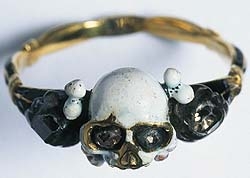
Today, we look back at the destruction wrought by the waves of plague and wonder how they survived without modern PPE. Mourning was the only way of life for many years. From that grief-stricken time, we have the legacy of mourning jewelry. (For more information about mourning jewelry view these posts, 1, 2.) Modern medicine does what it can to help monitor, prevent, and eradicate plagues both ancient and new, yet, the horrors of medieval suffering are still with us. What does the plague have to do with jewelry?
The plague created a knowledge gap. When artisanship resumed centuries later jewelry-making techniques, methods of production, and means of education were irrevocably changed. Each successive wave of plague across Europe reduced the Western capacity for artistry. Fine metalsmiths died, their students died, and the trade was not passed down from master to apprentice as it had been for previous millennia. Every living soul cared for the dying until, in some instances no one remained. The arts suffered not just during the plagues but in the aftermath.
It took roughly 1,000 years for the West to make it through the medieval period. During that time the majority of jewelry was gothic. Gothic style lingered well past the end of the Medieval period in the northern reaches of Europe even as it began to change in Italy at the start of the Renaissance. The popularity of Gothic styling endures and continues to resurface in fashion and architecture even today. Queen Victoria was a fan of Medival stylings. You can see the influence of ornate gothic details in Victorian designs. Slowly the continent emerged from the shadow of plague as the Renaissance, the rebirth, took place. Much of the metalsmithing techniques we use today are adaptations of Ancient Greek, and Middle Eastern design. The plague was not so ravenous in the Medieval Middle East or Grecian lands, and the arts survived. In many ways, craftsman guilds replaced the apprenticeship programs that existed previously in Europe. Post-plague a master craftsman would take on a group of apprentices and work with them to produce numerous art pieces all bearing the teacher’s name.
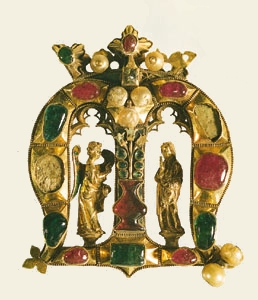
During the Renaissance, artist guilds produced most art, including jewelry. Ocassionally, a jewelry item was commissioned and crafted as a one-of-a-kind piece. More often, a class of 12 or more apprentices made identical items under the tutelage of a watchful craftsman, thus batch production was born. At the close of the medieval period, literacy rates were climbing, but the majority of laypersons could not read. The educational shift from one-to-one to one-to-many helped safeguard against the loss of knowledge including fine jewelry-making techniques, in a mostly illiterate society.
If the plague never ravaged the Western world, the gaps in fine jewelry production might not have existed. The growth of pre-medieval society might have proceeded on a smoother trajectory, but it is more likely that some other cataclysmic event would have caused a dip in growth at some point along the way. The idea-sharing that took place just before the Renaissance, the new development of one-to-many education, batch production, and the creation of more affordable jewelry and art, would not have occurred in the place and time that it did if it were not for the plague and its devastating effects.
Up Next…

Explore the worlds of jewelry and coins with weekly articles.
Find your next treasure, today!


 Pendant and Ring
What do you think?