
Freemasons are an extension of medieval Stonemason guilds established in London during the 17th century. Some lodges have records establishing membership guilds as early as 1600, but it is difficult to prove the history of any society with so much secrecy. [1]
Secret societies are frequently viewed with suspicion by the ruling classes. Queen Elizabeth I was no different. As an unmarried Royal, the last of the Stuart line, and a woman, she faced numerous naysayers and, thus distrusted secret keepers and secret societies.
The brick and stone masons had no voice in municipal proceedings during the medieval era and early Renaissance. These and other laborers formed guilds to gain a municipal voice. Those early guilds were a place for established laborers to air their grievances, and for apprentices and journeymen to receive education. As a group, a guild could improve the social fabric by donating to charities or doing charitable work for the municipality.
During the Renaissance, any powerful group was a threat to the monarchy. Especially, a protested protestant monarchy in a sea of Catholicism. Elizabeth the First was wary of powerful groups, guilds, and societies that could damage her monarchy.
Some of the Renaissance guilds developed into secret societies like the Freemasons. After the cathedrals were built the number of Freemasons began to dwindle so they opened their rolls to other tradespersons, merchants, and members of society.
Freemasons are not opposed to monarchy, and Elizabeth I’s successor James VI was a Freemason registered in Perth, Scotland. [2] Nor are they opposed to any religion or social group, saying they aim to help men be their best selves. Be that as it may, many groups oppose, or once opposed the Freemasons. Listen to the NPR Freemason article linked in the notes to learn about real and fictional Freemason secrets. [3]
The coin pendant in the image below in a Queen Elizabeth I Shilling. You can see some coin graffiti on both sides of the coin.
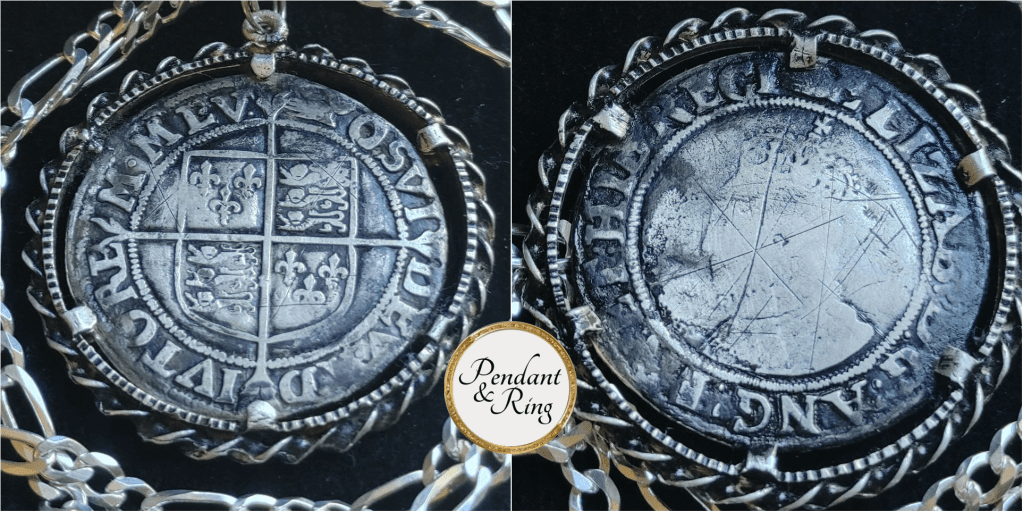
When you look closer at the graffiti some interesting patterns appear.
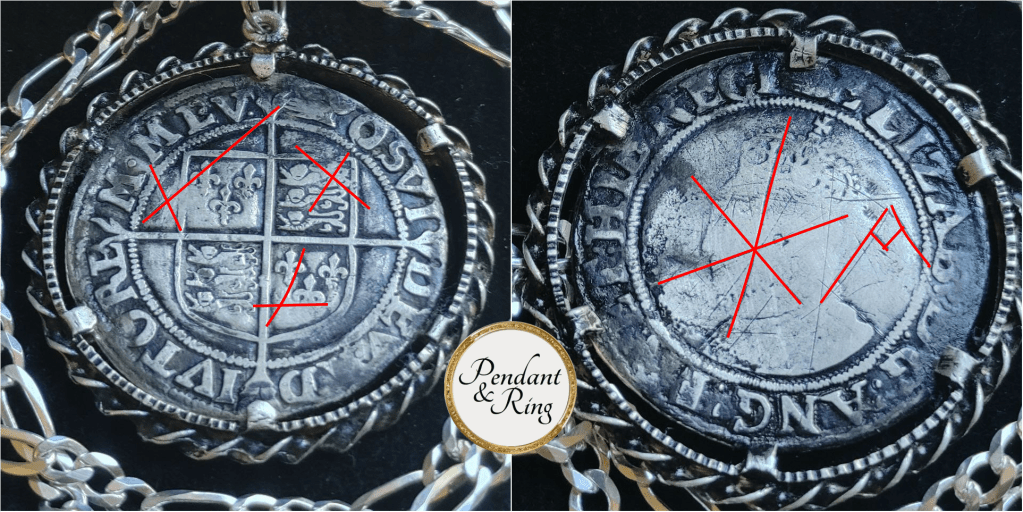
On the reverse we see the long cross through the shield, with different design in each quarter of shield, all inside a beaded circle, that begins with the hand mintmark at the top, then the abbreviated Latin legend surrounding: POSVI.DEV.ADIVTOREM.MEV
This translates to: I have made God my helper
There are three “X” marks on the reverse, perhaps indicating the Freemason triune circles of eternity which indicates abbreviations are to follow. [4]
On the obverse, the Crowned bust of Elizabeth I is facing left, inside a beaded circle, with an abbreviated Latin legend: ELIZAB.D.G.ANG:FR:ET:HIB:REGI:
Which translates to: Elizabeth by the Grace of God Queen of England, France, and Ireland.
Over the bust, we see a six-pointed star. The six-pointed star is a frequent motif in Freemason architecture and embellishment. It is typically rendered as two triangles, one up and the other down, but connecting the points through the center reveals this line-drawn star. [5]
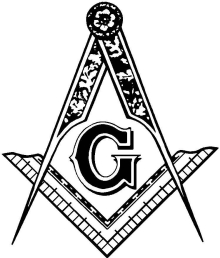
In the field behind the Queen, we see what could be a Freemason square and compass, a more familiar Freemason motif representing the Freemason fraternity member’s desire to live a decent and moral life represented by the square and the compass. [6]
Of course, these are not the only scratches on this coin. There are other markings on the obverse. Is this coin one of the first Freemason-marked coins? That’s for you to decide.
Thank you for joining us today.
Subscribe for more Pendant and Ring articles delivered to your inbox.
Visit Pendant and Ring on Etsy to find your next treasure!
PENDANT AND RING
Read More:
Not-so-secret Societies and Their Symbols
A History of Love Tokens
Queen Victoria’s Mourning Jewelry
Notes
[1] https://alki152.org/home/a-history-of-freemasonry/
[2] http://www.lodgescoonandperthno3.org.uk/A%20Short%20History%20of%20our%20Lodge.html
[3] https://www.npr.org/transcripts/112884584
[4] http://www.phoenixmasonry.org/AASR_1884_/15th_degree_knight_of_the_east_or_sword.htm
[5] https://archive.org/details/AnEncyclopaediaOfFreemasonryAndItsKindredSciencesVolumeOne/mode/2up?view=theater&q=six-pointed+star
[6] https://www.freemason.com/masonic-symbols-square-compasses/
 Pendant and Ring
What do you think?