
As it turns out, the history of the humble marivedi coin is a long and winding road.
Travel back in time with me to the early days of the second millenia, to the Medditeranian Islamic states in what would become Italy, Sicily, North Africa and Spain.
After the fall of Rome, and during the decline of Byzantium, the Fatimid and Umayyad Caliphates rose to power.
The extant monetary systems at the far edges of Byzantium were crumbling. Barter slowly replaced the hyperpyrons, solidi, and Byzantium bronze coins.
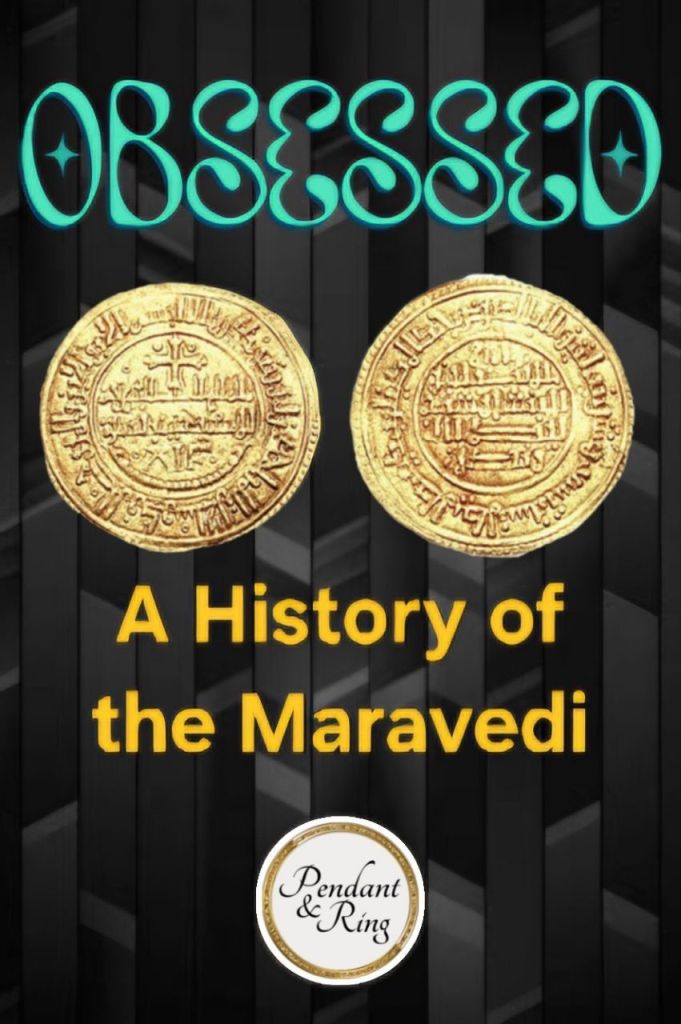
When the stability of new government settled, a new monetary system was put in place. The largest denomination in this system was the gold maravedi.
It was created on the Iberian peninsula, and derived from the Islamic gold dinar system which was modeled on Byzantium, and, previously, Roman gold solidus systems.
It was not a decimal or fractional system, but rather weight based. The weight of the coins and their metals determined their cost, or value, in a relationship to one another.
The Umayyad Caliphate minted gold maravedis and smaller coins in silver and bronze to facilitate trading around the Medditeranian.
Over the next five hundred years the Caliphate thrived, leveled out, and declined as empires are wont to do.
As times changed and the cost of goods changed, a gold maravedis became too expensive for the treasury to mint, and largely impractical for most trading. So the coin was devalued in relation to the coin’s metal. To maintain trade they started minting silver maravedies.
Any time in history when faith in a governance system declines, the value of their currency also declines. When the population is wary of their government, the price of precious metals increases.
By the 1500s, maravides were the common bronze coin. The kingdoms of Leon and Castile, not yet united, counterstamped each other’s coinage seeking financial dominance in contested regions.
When the fighting concluded, and the two kingdoms created a union, they sent their ships far and wide. It was the Age of Exploration.
The maravedi was reduced to a low-price token. Thirty-four maravedies made one real, sixteen reales made one escudo, and two escudoes made one excelente, the new gold coin.
A few centuries later, during the Revolutionary period, eight reales comprised the pirate’s piece-of-eight, equal to Spain’s Dolár, the US Dollar, and the Mexico Peso.
In 1831, Spain minted the last maravedies on the Iberian Peninsula. I told you it was a long and winding road.
Thank you for joining us on this journey through time.
Subscribe for more adventures!
Find your very own maravedí in the Pendant & Ring Etsy store.
Read more from Pendant & Ring. Explore the new articles, or the archives using the menu.
 Pendant and Ring
What do you think?